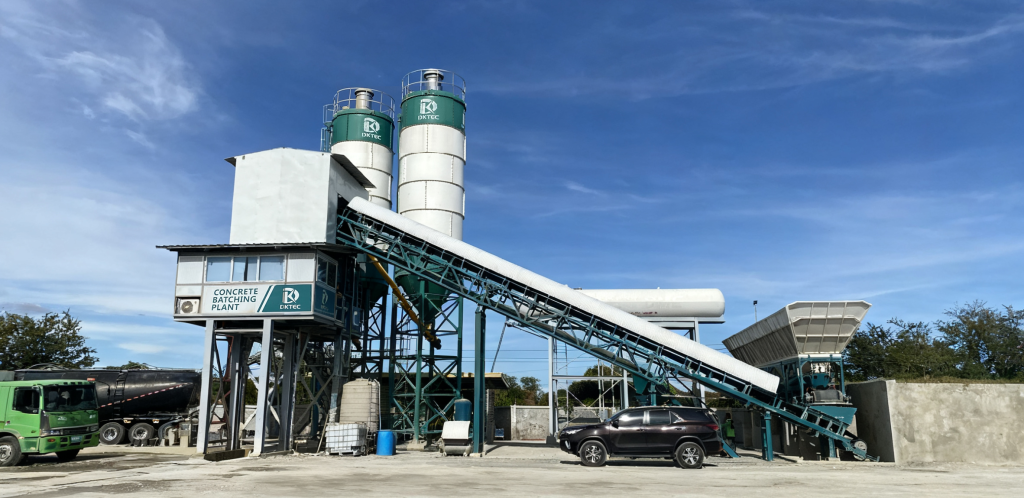
Crushing plant is a critical engineering facility in mining, aggregate production, and construction waste recycling. Its primary function is to break down large rocks or concrete debris through mechanical force into aggregates that meet specific size requirements.
What is a Crushing plant? System Components & Working Principle
A complete crushing plant is not a single piece of equipment, but a closed-loop system consisting of four core modules:
- Feeding System: Vibrating feeders uniformly deliver raw materials into the crusher while pre-screening soil and fine particles.
- Crushing System: Consists of primary coarse crushing (e.g., jaw crushers) and secondary medium/fine crushing (e.g., cone or impact crushers).
- Screening System: Vibrating screens classify the crushed materials by size, sending compliant products to stockpiles and returning oversized materials for re-crushing.
- Conveying System: Belt conveyors efficiently transfer materials between processing stages.
Core Classification & Comparison
Based on structural form and mobility, crushing plants are primarily divided into Stationary Crushing plants and Mobile Crushing plantd (including crawler/tracked and wheeled types).
| Feature | Stationary Crushing Plant | Mobile Crushing Plant |
| Applications | Large-scale long-term mines, major aggregate plants | Urban construction waste, short-term projects, confined sites |
| Capacity | Very High (up to 1,000+ tons/hour) | Medium-Small (typically 50 – 400 tons/hour) |
| Infrastructure Cost | High (requires concrete foundations) | Very Low (ready to use, no foundation needed) |
| Flexibility | Extremely Low (fixed once built) | Extremely High (self-propelled track/wheel, easy relocation) |
| Transport Cost | Requires hauling raw materials to the station | Crushes at the source, significantly cutting haulage fees |
Core Crusher Types & Selection Logic
- Jaw Crusher: Primary choice for coarse crushing. High crushing force, ideal for hard, abrasive ores (e.g., granite, basalt).
- Cone Crusher: Ideal for secondary medium/fine crushing. Long wear-part life, highly suited for hard materials with uniform product size.
- Impact Crusher: Best for medium-soft materials (e.g., limestone). Excellent cubical product shape with minimal elongated particles, though wear parts consume faster.
- Vertical Shaft Impact Crusher (VSI / Sand Maker): Used for tertiary shaping and sand making. Utilizes rock-on-rock impact to produce high-quality manufactured sand.
Industry Trends: Intelligence & Sustainability
- Smart Controls: Integrated PLC and IoT sensors monitor bearing temperatures, vibration levels, and liner wear in real time for predictive maintenance.
- Dust Suppression: Enclosed belt corridors, baghouse dust collectors, and high-pressure fogging systems help achieve near-zero dust emissions.